
Greater Manchester vs London: Where Overseas Investors Are Putting UK Property Capital in 2026

There’s a persistent assumption that overseas investors buying UK property are chasing Prime Central London.
Postcode prestige.
Luxury towers.
Headline locations.
That assumption is outdated.
In conversations I’ve had over the past 18 months with investors in Singapore, Dubai, Hong Kong and mainland China, the question has shifted.
It’s no longer:
“What’s the most famous postcode?”
It’s now:
“Where does UK property investment actually work?”
Increasingly, the answer is Greater Manchester.
Not because it’s fashionable.
Because it functions.
I Own London Property — But I Wouldn’t Expand There Today
For context, I’m from London.
I own rental property in London.
London remains globally significant. It offers liquidity, depth, and long-term capital appeal.
But if allocating fresh capital in 2026 purely on income resilience and structure, I would not
expand my London portfolio.
Why?
Because the numbers behave differently.
Average London investment stock frequently requires:
Entry prices above £500,000
Gross rental yields between 3.5%–4%
That changes leverage dynamics.
If an asset requires consistent monthly support, it stops being an anchor and becomes exposure.
For overseas investors managing currency risk, tax complexity and time-zone distance, that distinction matters.
Rental Yield Comparison: Manchester vs London (2026)
Here’s the practical difference:
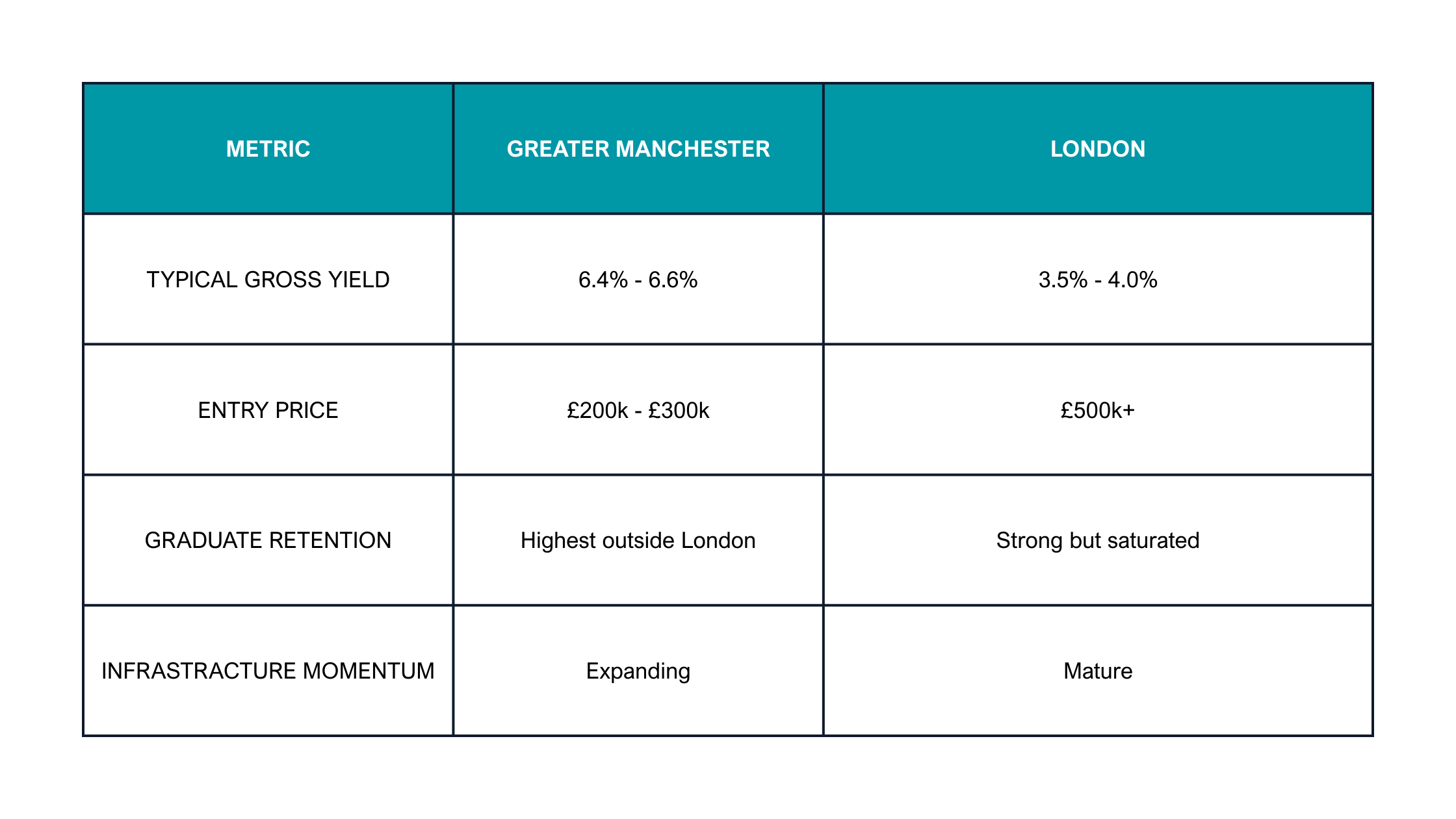
The yield gap is not cosmetic.
A 6.5% yield versus 4% materially affects:
Cash flow stability
Rate sensitivity
Stress tolerance
Long-term compounding
For an overseas investor financing at 70–75% loan-to-value, that difference determines whether the asset sustains itself or requires ongoing subsidy.
This is not about chasing high yield.
It’s about building resilient structure.
For an overseas investor financing at 70–75% loan-to-value, that difference determines whether the asset sustains itself or requires ongoing subsidy.
This is not about chasing high yield.
It’s about building resilient structure.
Why Greater Manchester Property Investment Works
1. ACCESSIBLE ENTRY PRICING
Manchester investment properties often sit between £200,000 - £300,000.
This allows:
Conservative leverage
Reduced concentration risk
Scalable portfolio growth over time
London’s higher entry point creates binary exposure.
Manchester allows calibration.
2. STRUCTURAL RENTAL DEMAND
The Manchester rental market is not driven by speculation.
It is anchored to:
A six-figure student population
Strong graduate retention (highest outside London)
Expanding tech, healthcare and professional sectors
Ongoing regional economic investment
Rental demand tied to employment is more durable than demand driven by capital flows.
3. INFRASTRACTURE EXPANDING RENTAL GEOGRAPHY
Infrastructure directly affects rental resilience.
The Bee Network is integrating buses, trams and rail across Greater Manchester.
The £1.3bn transformation of Manchester Airport’s Terminal 2 enhances international connectivity.
These are not cosmetic upgrades.
They expand viable rental zones and strengthen long-term tenant mobility.
What Overseas Investors Actually Ask
When speaking with overseas and expat investors, the questions are rarely emotional.
They are structural:
Will rental income cover borrowing?
Is UK landlord regulation manageable from abroad?
Who handles compliance (EPC, EICR, licensing)?
Who is responsible if something goes wrong?
Is the legal framework predictable?
These are not speculative investors.
They are looking for:
Stable rental income
Sensible leverage
Clear UK regulation
Professional local management
Greater Manchester consistently answers those requirements more efficiently than Prime London at current pricing.
UK Property Investment From Asia: Why the Focus Is Shifting
Investors based in Asia increasingly prioritise:
Income efficiency over postcode prestige
Lower entry exposure
Diversification potential
Operational clarity
London remains globally recognised.
But for investors prioritising yield, resilience and structure, regional UK cities — particularly Manchester — now offer stronger income fundamentals.
This is not anti-London.
It is capital discipline.
The Real Opportunity in 2026
The opportunity is not buying what is loud.
It is buying what works.
For overseas investors evaluating UK property in 2026, Greater Manchester offers:
Higher gross rental yields
Lower capital entry
Structural employment demand
Infrastructure momentum
Scalable investment strategy
It does not offer glamour.
It offers function.
And in long-term investing, function tends to outperform fashion.
Final Thought: Overseas UK Property Investment Requires Structure
Overseas investors do not need trophy assets.
They need:
Resilient income
Sensible leverage
Transparent UK compliance
Professional management
A functioning city
Right now, Greater Manchester satisfies those criteria more consistently than Prime London at equivalent risk levels.
The gap is not demand.
It is guidance.
Understanding where UK property fundamentals genuinely stack up — and building around that.
That is the conversation shifting quietly across Asia.
And it is why Manchester is increasingly where overseas capital lands.
